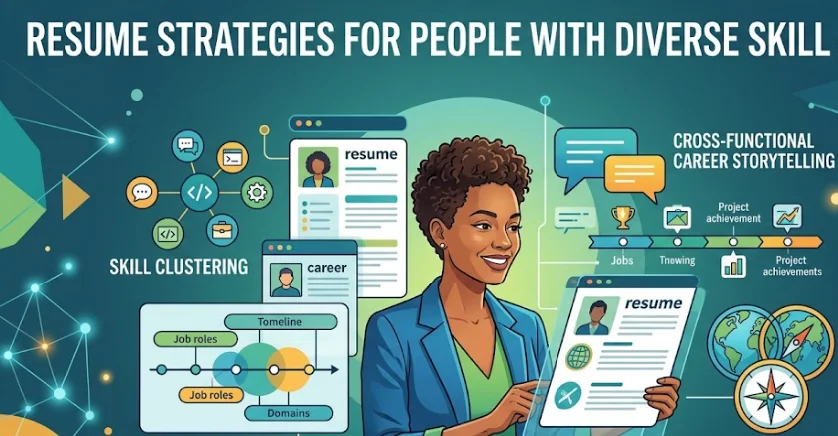
Professionals with diverse skill sets often struggle with a unique challenge: how to present multiple strengths without appearing unfocused. Unlike linear career paths, multi-skilled profiles include varied experiences across roles, industries, or functions. While this diversity is valuable, it can become confusing if not structured properly in a resume. The goal is not to hide diversity, but to organize it in a way that feels intentional, relevant, and cohesive.
What Diverse Skill Sets Actually Mean
A diverse skill set refers to a professional who has developed capabilities across multiple domains or roles.
This may include:
- Technical and non-technical skills combined
- Experience across different industries
- Multiple functional roles such as marketing, operations, or design
These profiles are increasingly common in modern, flexible work environments.
Why Traditional Resumes Fail Multi-Skilled Professionals
Traditional resumes are designed for linear career progression. This creates challenges for diverse skill profiles.
Problems include:
- Skills appearing disconnected or scattered
- Difficulty identifying a clear professional identity
- Overemphasis on job titles instead of capabilities
As a result, strong but varied experience can look unfocused.
Core Principle: Organize by Themes, Not Job Titles
The most effective strategy is to shift from role-based structure to theme-based structure.
Instead of listing jobs chronologically alone, group experience by:
- Core skill areas
- Types of problems solved
- Functional expertise domains
This helps create clarity across diverse experiences.
Using Skill Clusters Instead of Random Lists
Skill clustering is essential for making diverse abilities understandable.
Instead of listing skills randomly, group them into categories such as:
- Technical skills
- Analytical skills
- Creative or design skills
- Leadership or communication skills
This structure improves readability and relevance.
Best Resume Structure for Diverse Skill Sets
A hybrid resume structure works best for multi-skilled professionals.
It typically includes:
- Strong professional summary defining overall positioning
- Skill clusters organized by theme
- Project or experience section grouped by relevance
This approach balances flexibility with clarity.
Creating a Unified Career Story
Even with diverse skills, your resume must tell a consistent story.
A strong narrative includes:
- A central professional identity or focus area
- Logical connections between different roles or skills
- A clear explanation of how your skills complement each other
Without this story, diversity can feel fragmented.
Tailoring Skills to Job Relevance
Not all skills need to be emphasized for every job application.
Effective tailoring includes:
- Highlighting only relevant skill clusters for the role
- Reordering sections based on job priority
- Minimizing unrelated experience visibility
Relevance helps focus attention on the right strengths.
Turning Skills Into Proof Through Experience
Diverse skills become powerful when supported by real examples.
Instead of only listing skills, demonstrate them through:
- Projects that show cross-functional ability
- Achievements that combine multiple skill areas
- Outcomes that reflect applied knowledge
Proof transforms variety into credibility.
Common Mistakes Multi-Skilled Professionals Make
Several mistakes reduce the effectiveness of diverse skill resumes.
These include:
- Listing too many unrelated skills without grouping
- Failing to define a central professional identity
- Using job titles as the only organizing structure
- Not prioritizing relevance for target roles
These issues create confusion instead of clarity.
Before and After Examples
Before:
- Worked in marketing, data analysis, design, and operations with no clear structure or connection between roles
After:
- Organized experience into skill clusters including data analysis, marketing strategy, and operational optimization, demonstrating how each capability contributes to business performance improvement
Before:
- Random list of skills including Excel, graphic design, communication, and project management
After:
- Structured skill groups including analytical tools (Excel, data modeling), creative skills (design, branding), and leadership skills (project management, communication)
Before:
- Multiple unrelated job roles listed without context or narrative connection
After:
- Career experience grouped by functional themes showing progression in problem-solving, strategy, and execution across different industries
Conclusion
Diverse skill sets are an advantage when presented correctly. The challenge is not the variety itself, but the lack of structure around it.
By organizing skills into clear themes, creating a unified career story, and focusing on relevance, multi-skilled professionals can transform complexity into clarity.
A well-structured resume does not simplify your experience. It clarifies it, making your versatility a strength rather than a source of confusion.